
Discussion Guide · Leadership
Adoption Conversations for Steering Committees
Prompts that move governance from delivery status to adoption position.
- Format
- 8 pages
- Sections
- 8
- Checklist items
Contents (8 sections)
- 01Move from "What did we complete?" to "What condition exists?"
- 02Engagement: Who still needs to participate?
- 03Enablement: Can people actually perform?
- 04Evidence: What gives us confidence?
- 05Recovery: What should already exist but does not?
- 06Look ahead: What must become true before the next gate?
- 07Make leadership decisions explicit
- 08Seven questions for every steering committee
Steering committees are good at asking whether a transformation is on schedule.
Is design complete? Is testing on track? Is training scheduled? Are we still targeting the planned go-live date?
Those questions are necessary for delivery governance.
But they can create a dangerous assumption:
If the project is progressing, the organization must be progressing with it.
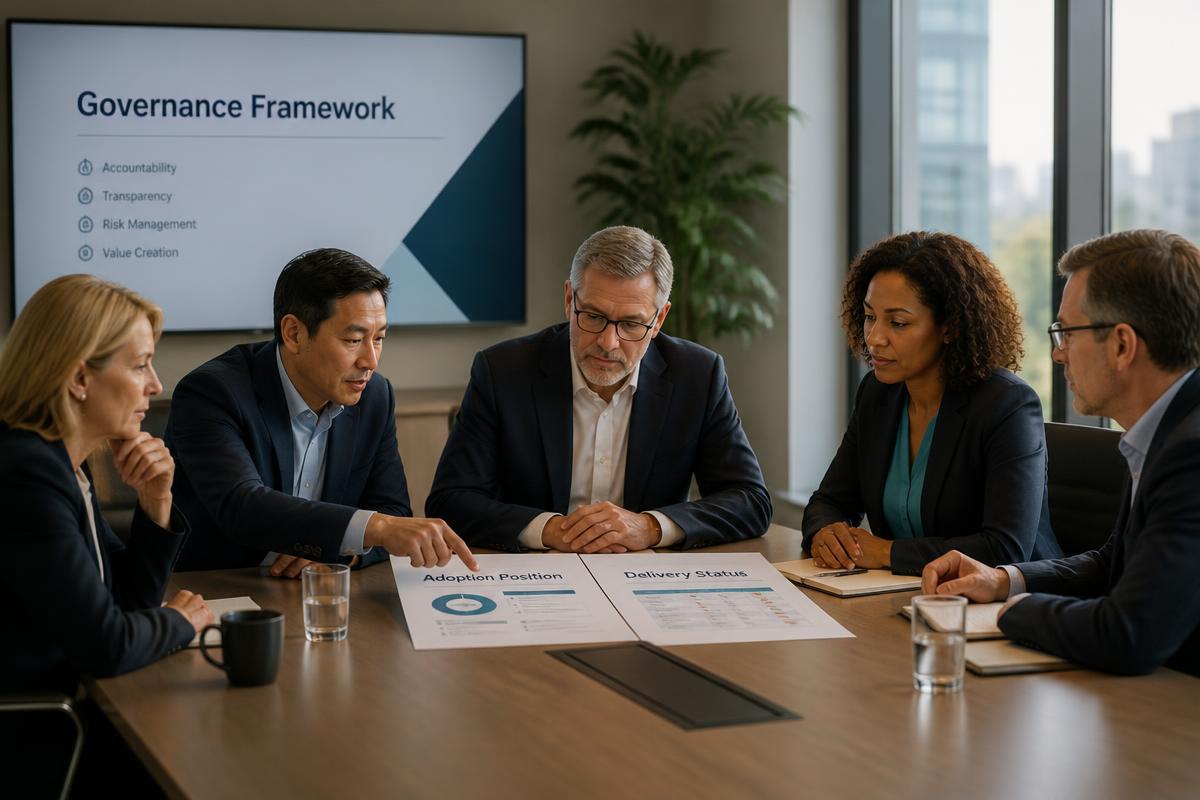
AdoptionOS deliberately separates the official delivery position from the Adoption Position because the two can move at different speeds. A program may be entering UAT while important stakeholder, impact, leadership or enablement foundations remain incomplete. Those earlier obligations do not disappear because the project schedule moved forward; they become Recovery work.
Steering committees therefore need a second conversation alongside delivery status:
Where does adoption actually stand?
01Move from "What did we complete?" to "What condition exists?"
Traditional governance questions often begin with activity:
Have communications gone out?
Instead ask:
Do the people whose participation matters understand the change and know what is expected of them?
Has training started?
Instead ask:
Which populations can currently perform what will be expected of them, and where are capability gaps still visible?
Have we completed the stakeholder plan?
Instead ask:
Which stakeholders still need to participate in a decision, validation or local action before we can proceed confidently?
Is the readiness assessment complete?
Instead ask:
What evidence supports our current readiness judgment, and where is that evidence incomplete, contradictory or stale?
The shift is subtle but important.
One conversation reports the work.
The other examines the condition the work was intended to create.
02Engagement: Who still needs to participate?
ABEN's Adoption Formula™ begins with Engagement:
Adoption = Engagement + Enablement + Evidence
Engagement is not communication volume. It includes understanding, meaningful participation, credible leadership, manager involvement and the stakeholder actions necessary to move the transformation forward.
Useful steering committee prompts include:
- Which stakeholder groups are materially under-engaged?
- Which leaders or business owners have decisions outstanding?
- Where are managers not yet equipped to explain the change to their teams?
- Which impacted populations have been informed but not meaningfully involved?
- What stakeholder concern could become an operational issue if it remains unresolved?
- Where are we relying on communication when participation is actually required?
The committee should then ask:
What leadership action is needed?
Engagement risks are often resolved not by another communication, but by access, participation, ownership or a decision.
03Enablement: Can people actually perform?
Training status is one input into enablement.
It is not the entire question.
AdoptionOS defines Enablement more broadly: people require role clarity, process understanding, knowledge, skill, access, tools, performance support and operational support to perform the intended way of working.
Steering committees can ask:
- Which roles face the greatest performance change?
- Which populations are not yet sufficiently prepared?
- Are access, environments, tools and job support arriving when people need them?
- What have testing, training or simulations revealed about capability?
- Which critical roles have limited opportunity to practice before go-live?
- What will employees still need after formal training ends?
- Where could a training problem actually be a process, role, access or system-design problem?
The most important prompt is:
What would prevent this population from performing on day one?
That question often exposes risks that a training-completion percentage cannot.
04Evidence: What gives us confidence?
A steering committee should be cautious whenever it hears statements such as:
Users are ready.
Leadership is aligned.
Training is on track.
The business is comfortable.
The next question should be:
What is that conclusion based on?
Evidence is the third pillar of ABEN's Adoption Formula™. It includes not only metrics, but the source, quality, timing, ownership, limitations and interpretation of the information being used to make a decision.
Ask:
- What evidence supports this conclusion?
- Is the evidence current?
- Does it cover the populations most affected?
- Are we looking at participation or simply attendance?
- Are we measuring capability or only training completion?
- What do we currently not know?
- Where do different sources tell us different things?
- What evidence would cause us to change our current position?
Good governance does not require perfect information.
It requires transparency about the information being used.
05Recovery: What should already exist but does not?
This may be one of the most valuable steering committee conversations.
Projects advance according to delivery milestones. Adoption work is less orderly.
An organization may reach testing before impacts are adequately understood.
Training may begin while role definitions remain unresolved.
Go-live may approach while business ownership after hypercare is still unclear.
AdoptionOS does not move the project backward when this happens. Instead, earlier obligations that remain necessary are surfaced as Recovery alongside current work.
Ask:
- What adoption foundation should have been established by this point?
- Which earlier obligations remain incomplete or weak?
- What consequence does that create now?
- Can the gap realistically be recovered before the next major gate?
- If it cannot, what mitigation is required?
- Who owns the recovery action?
- Which recovery items require explicit leadership risk acceptance?
This prevents schedule progression from hiding adoption debt.
06Look ahead: What must become true before the next gate?
Governance should not only evaluate today's status.
It should identify the adoption conditions required for the next significant decision.
Before UAT, ask what business participation and impact clarity must exist.
Before training, ask whether audiences, roles, processes, environments and content are sufficiently stable.
Before go-live, ask whether people can perform, support is ready and unresolved adoption risks are understood.
Before hypercare exit, ask whether capability and ownership are transferring successfully to the business.
A useful steering prompt is:
What must be true from an adoption perspective before we reach the next major project milestone?
Then:
What evidence will tell us whether it is true?
This connects adoption governance directly to the delivery calendar without treating the two as identical.
07Make leadership decisions explicit
Steering committees should not receive adoption risks without knowing what leadership needs to do about them.
For every material issue, ask:
- What is the issue?
- What is the consequence?
- What evidence supports it?
- Who owns it?
- What decision or action is required?
- By when?
AdoptionOS uses this decision-oriented structure because leadership guidance should lead to action rather than become another section of a status report.
08Seven questions for every steering committee
A transformation does not need dozens of adoption slides at every meeting.
Seven questions can create a much stronger conversation:
- Where does adoption actually stand relative to the project?
- Which people or groups require greater participation?
- Where are capability gaps most likely to affect operations?
- What evidence gives us confidence and what remains unknown?
- What earlier adoption work requires Recovery?
- What must become true before the next major milestone?
- What leadership decision or action is required now?
These questions change the purpose of adoption reporting.
The steering committee stops asking only:
Is the change workstream on track?
It starts asking:
Are the conditions for adoption developing at the pace this transformation requires?
That is a much stronger governance conversation.
Put this into practice in your program.
AdoptionOS Consulting helps leadership teams build the operating discipline, evidence and governance to move from delivery to adoption.