
Adoption Framework · Enterprise Adoption
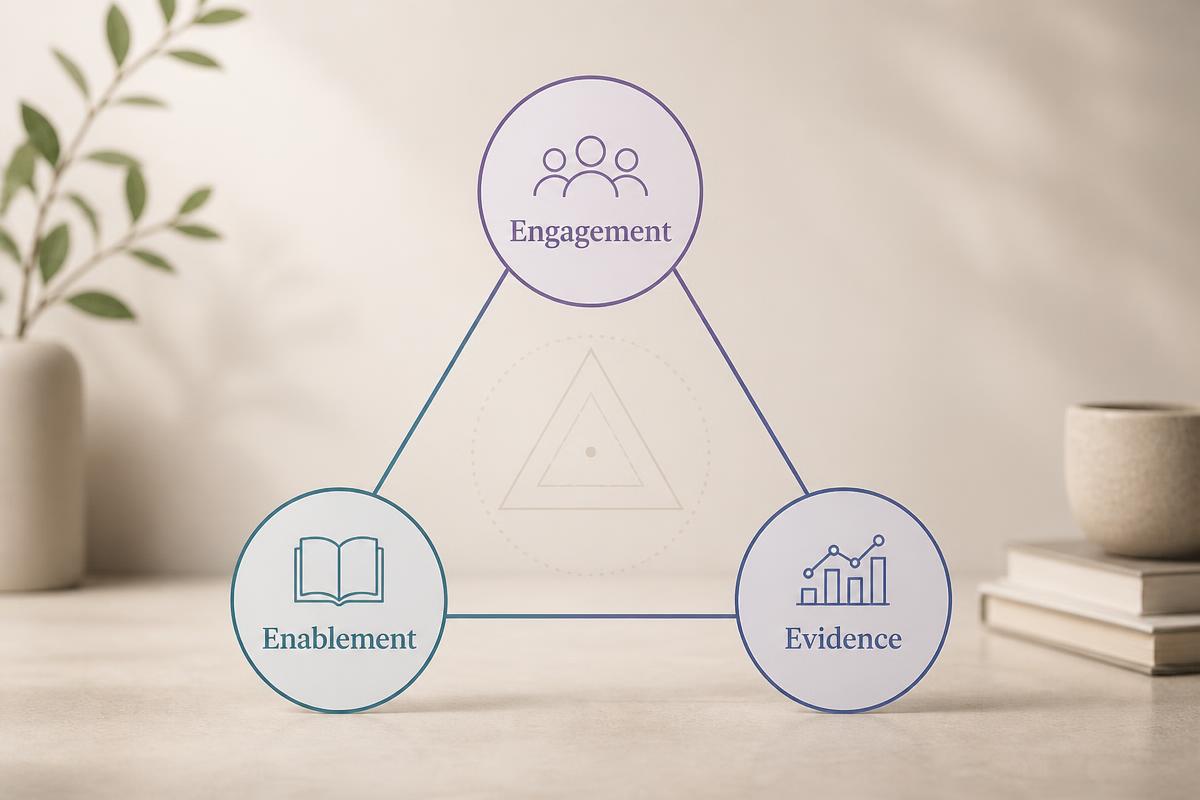
ABEN's Adoption Formula™ Working Framework
The Formula as a working structure for planning and reviewing adoption.
- Format
- 12 pages
- Sections
- 9
- Checklist items
Contents (9 sections)
- 01Adoption = Engagement + Enablement + Evidence
- 02Engagement: Are people meaningfully connected to the change?
- 03Enablement: Can people perform the new way of working?
- 04Evidence: What gives us confidence?
- 05Do not turn the Formula into three separate workstreams
- 06Use the Formula to plan adoption
- 07Use the Formula to review adoption
- 08Use the Formula to simplify leadership conversations
- 09A working framework, not another checklist
Adoption can become complicated very quickly.
A transformation may have stakeholder plans, communications, training, readiness assessments, support models, surveys, leadership activities, analytics and dozens of individual deliverables.
The challenge is not usually a lack of activity.
It is determining whether all of that work is creating the conditions people need to adopt a new way of working.
01Adoption = Engagement + Enablement + Evidence
The Formula is not a mathematical equation or a prediction that three scores will produce adoption. It is a governing framework for organizing the work, asking better questions and identifying where adoption conditions may be weak.
It can be used throughout a transformation to plan adoption, review progress and guide leadership attention.
02Engagement: Are people meaningfully connected to the change?
Engagement is broader than communication.
It considers whether people understand the change, experience credible leadership, participate where their involvement matters, and receive the manager and stakeholder support needed to move with the transformation.
When planning, ask:
- Who must understand the change?
- Who must participate in shaping or validating it?
- Which leaders must make decisions or reinforce expectations?
- Which managers need to translate the change for their teams?
- Which stakeholders could materially influence success or create risk?
- Where will two-way participation be more important than one-way communication?
When reviewing, move beyond counting messages and meetings.
Ask instead:
Did the right people participate, and did that participation influence the transformation?
A communication may have been delivered.
A stakeholder meeting may have occurred.
A town hall may have reached thousands of employees.
Those activities matter but they do not, by themselves, prove engagement.
03Enablement: Can people perform the new way of working?
Enablement is broader than training.
It includes the role clarity, process understanding, knowledge, skill, access, tools, performance support and operational support people require to perform successfully.
When planning, ask:
- What will people need to do differently?
- Which roles are changing?
- What must each audience understand?
- What must they be able to perform?
- What access, tools and environments will they require?
- What should formal training address?
- What can be supported through job aids, managers, super users or embedded guidance?
- What support will remain necessary after go-live?
This changes the objective from:
How will we train everyone?
to:
What must be true for these people to perform successfully?
Training becomes one intervention within a broader capability system.
When reviewing enablement, course completion should therefore be only one signal.
The more important question is whether people have what they need to perform.
04Evidence: What gives us confidence?
Evidence prevents adoption from becoming a collection of untested claims.
It includes the information used to understand whether work exists, whether it is credible, whether people participated, whether capability is developing, whether behaviors are appearing, what outcomes are emerging and what limitations remain.
Evidence is also where measurement and analytics belong within the Formula.
But Evidence is broader than dashboards.
It includes the source of information, its quality, timing, ownership, limitations, interpretation and the decision it should inform.
When planning, ask:
- What will tell us whether the intended condition exists?
- Where will that information come from?
- Who owns it?
- When should it become available?
- What decision will it support?
- What would make the evidence insufficient or misleading?
For example:
If the objective is stakeholder participation, attendance may be useful but participation in decisions may be stronger evidence.
If the objective is workforce capability, training completion may be useful but assessment results, support patterns or observed performance may tell us more.
If the objective is sustained adoption, a launch survey may be useful but production behavior and business performance may eventually provide stronger evidence.
Do not claim more than the evidence supports.
05Do not turn the Formula into three separate workstreams
The greatest value comes from using Engagement, Enablement and Evidence together.
They are connected conditions.
Strong communication cannot indefinitely compensate for employees who cannot perform.
Excellent training cannot resolve missing leadership decisions.
A sophisticated dashboard cannot repair weak stakeholder participation.
And activity in all three areas still does not mathematically prove adoption. The Formula is intentionally a working model, not a predictive equation.
Consider a new procurement process.
Engagement asks whether procurement leaders, managers and affected users understand and participate in the change.
Enablement asks whether buyers, approvers and requestors know how to perform their new responsibilities and have the required tools and access.
Evidence asks what demonstrates that those conditions exist and whether additional intervention is needed.
The three lenses describe one adoption problem.
06Use the Formula to plan adoption
At the beginning of a transformation, apply the Formula to each significant change, audience, wave or business capability.
For each, establish:
Engagement Who needs to understand, participate, decide or reinforce?
Enablement What must people know, possess or be able to do?
Evidence What information will tell us whether those conditions are developing?
This creates a stronger adoption plan because activities originate from required conditions rather than from a standard checklist.
07Use the Formula to review adoption
During delivery, use the same structure to challenge progress.
For each major population or change:
Engagement: Are the necessary people participating?
Enablement: Are they becoming capable of performing?
Evidence: What supports those conclusions?
Where the answer is weak, ask what intervention is required next.
That might mean additional communication.
It might mean a leadership decision.
It might mean role clarification, targeted practice, access remediation, stronger manager involvement, additional support or better evidence.
The Formula does not prescribe the same intervention every time.
It helps expose which condition needs attention.
08Use the Formula to simplify leadership conversations
Executives do not need to review every adoption deliverable.
The Formula provides a simpler way to structure the conversation:
Are people engaged? Are they enabled? What evidence supports our confidence?
Then ask:
Where is the weakness, what is the consequence, and what decision or action is required?
That turns adoption reporting away from long activity lists and toward decisions.
09A working framework, not another checklist
ABEN's Adoption Formula™ is most useful when it becomes a lens applied repeatedly across the transformation.
- Use it when planning a wave.
- Use it when reviewing a stakeholder group.
- Use it before training.
- Use it before go-live.
- Use it during hypercare.
- Use it when adoption appears to be struggling.
- And use it after the project team has left.
The objective is not to prove that the formula has been "completed."
It is to keep asking whether the conditions supporting adoption are actually developing:
Are people engaged? Are they enabled? And what evidence tells us so?
That is how the Formula moves from a concept to a working adoption discipline.
Put this into practice in your program.
AdoptionOS Consulting helps leadership teams build the operating discipline, evidence and governance to move from delivery to adoption.